FINDINGS / PARK ROYAL CLAY
Park Royal Clay Findings
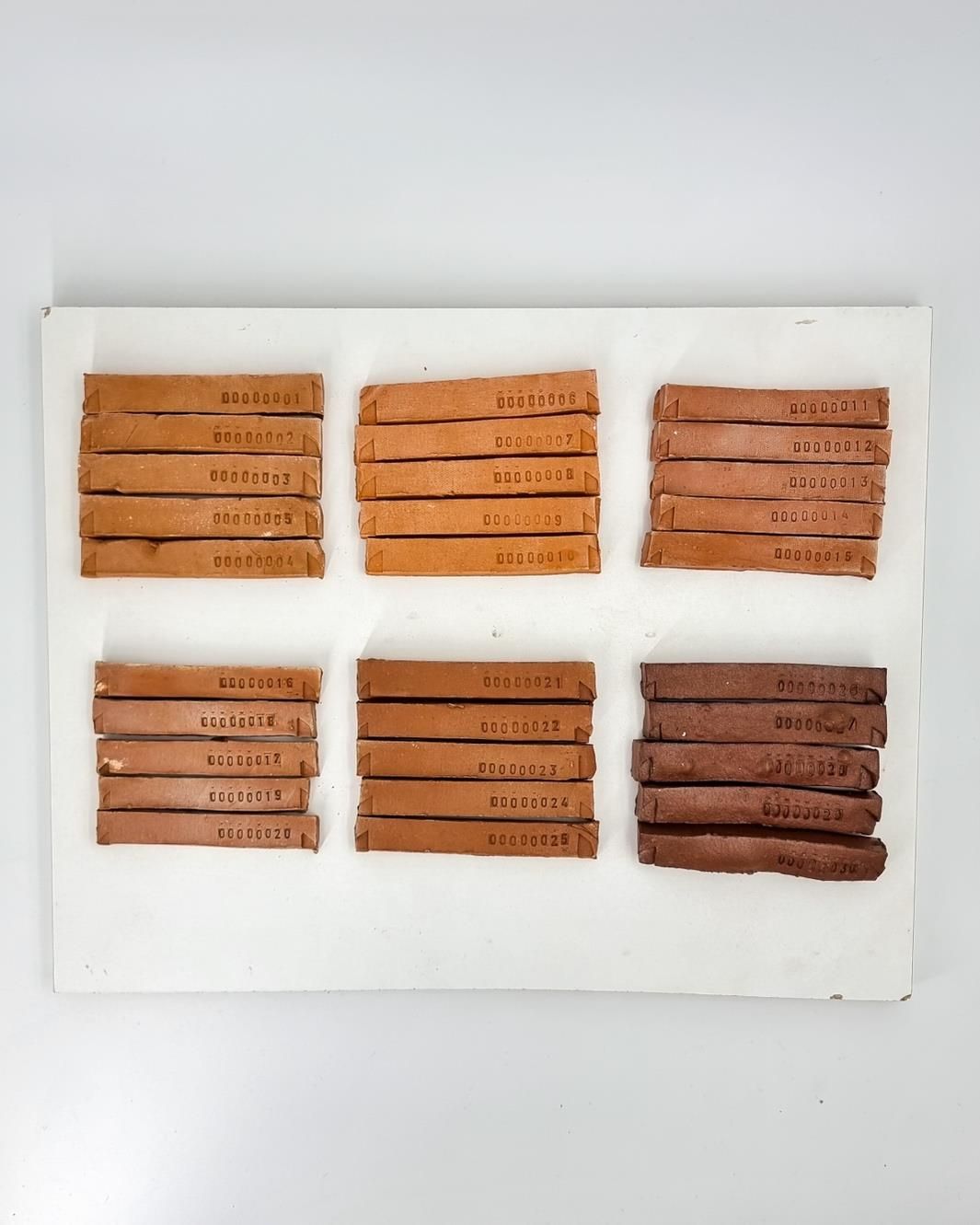
Thirty fired test tiles across six temperature batches, from 700 to 1150 C. All measurements from the fired test bars; pre-firing length constant at 10 cm.
Key finding
As it comes, this clay was not suited to slip casting. Every sodium deflocculant tried either did nothing or gelled the slip. Adding 2.5% barium carbonate makes it fully suitable for slip casting.
Firing results
Per-batch averages computed from all 30 tiles. Linear shrinkage measured against 10 cm pre-firing length.
| Batch | Max temp (C) | Linear shrinkage (%) | Water absorption (%) |
|---|---|---|---|
| A | 700 | 9.2 | 17.6 |
| B | 900 | 11.1 | 10.7 |
| C | 1000 | 15.1 | 5.1 |
| D | 1050 | 15.8 | 0.7 |
| E | 1100 | 9.6 | 24.8 |
| F | 1150 | 11.9 | 38.3 |
Hover or tap a point on either chart for the exact values.
What the data shows
Water absorption falls as the clay is fired hotter and reaches its lowest, tightest state around 1050 C (0.7%). Above that the clay over-fires: absorption climbs steeply (about 25% at 1100 C and 38% at 1150 C) and the bars begin to bloat, so net shrinkage also drops. In short, this clay is at its best near 1050 C, where it is densest and most watertight.
Pre-processing
The raw clay is broken into chunks, dried completely, then slaked in water until it disaggregates. The slaked clay is mixed, sieved through a 100 mesh, and hardened on a plaster batt before test tiles are formed. Firing schedule: 100 degrees Celsius per hour to 600 degrees Celsius, then full ramp to the batch maximum.
Full batch data, photos, and lab notes in Notion. Opens in a new tab.
If your site produces clay like this, work with us. We take clean London construction clay in small documented quantities, test it in the open, and publish what we find.
Bring excavated London clay to the studio